
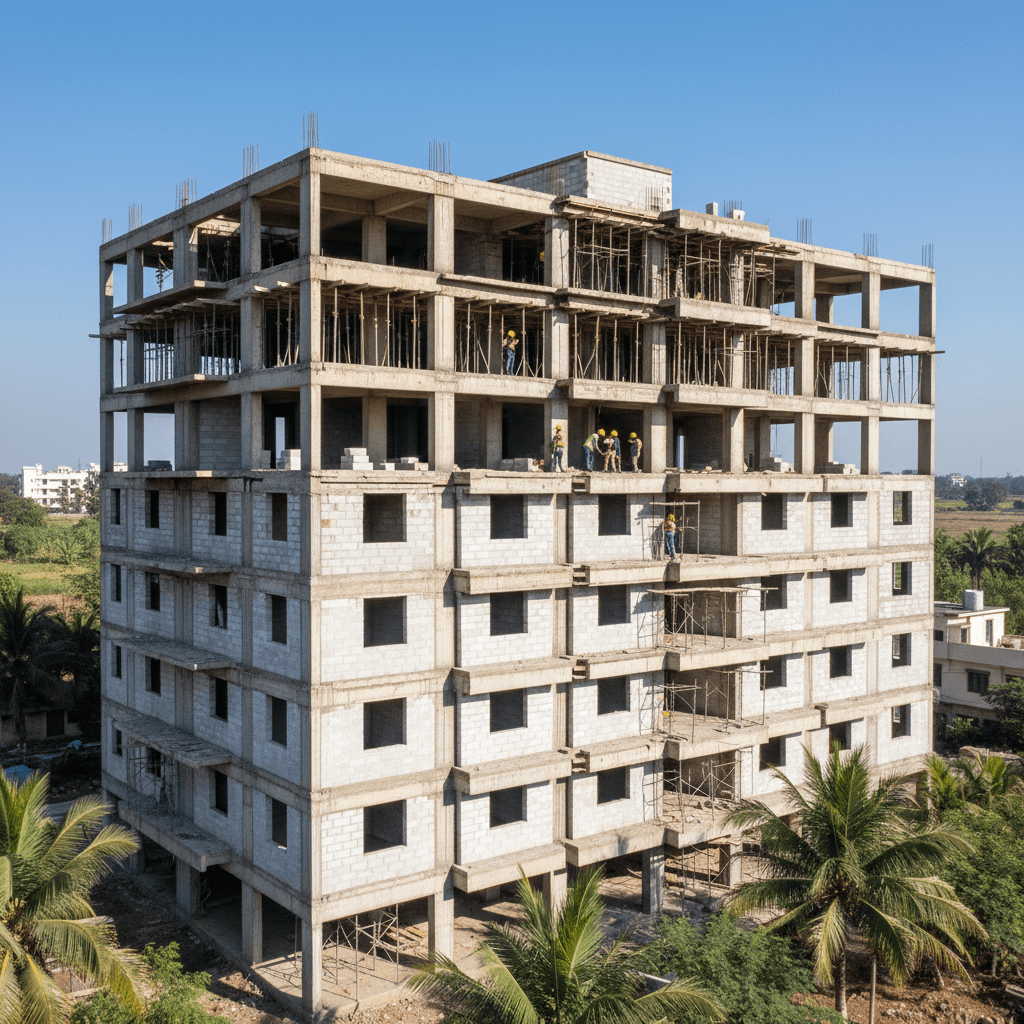
The first phase of a substantial care-home complex in Meerut, Uttar Pradesh, India, built with hempcrete, is nearing completion. This project is being developed by Nepal-based Shah Hemp Inno-Ventures (SHIV) and represents a significant milestone in the company’s decade-long effort to establish commercial and social infrastructure using industrial hemp across South Asia.
The complex is planned to span approximately two acres, featuring a 40,000-square-foot facility constructed with hempcrete walls around reinforced concrete framing. The smallest building within this development, measuring roughly 7,000 square feet, has now been completed, according to Dhiraj Shah, co-founder of SHIV. A crew of 10 workers received on-site training from SHIV and has since moved to commence work on the main building, which is projected for completion by September 2027, as reported by Hemp Today.
Building with Hempcrete at Scale
Dhiraj Shah stated that this project demonstrates the practicality of hempcrete for larger-scale construction. He noted its capacity to reduce the reliance on conventional building materials while potentially enhancing both thermal and environmental performance. Most of the external and internal wall space was cast using the form-infill method.
- Thermal Insulation: Hempcrete’s inherent properties may contribute to thermal insulation, potentially supporting stable indoor temperatures.
- Breathability: The material allows for natural moisture regulation, which may contribute to indoor air quality.
- Material Reduction: Shah indicated that the project achieved a saving of approximately 20% in concrete material that would otherwise have been necessary.
Shah emphasized that hempcrete is considered well-suited for care facilities due to its thermal insulation, breathability, and natural characteristics. While hempcrete forms the majority of the wall structure, some brick is also being incorporated into the construction.
A Decade of Industrial Hemp Development
The work on this complex reflects a long-standing vision articulated by SHIV founders Dhiraj Shah and Nivedita Bansal Shah. Following Nepal’s 2015 earthquake, they initially proposed that hemp-based building materials could offer affordable and resilient housing and public facilities in the Himalayan region. SHIV was established to develop commercial applications for locally sourced hemp, simultaneously fostering economic opportunities in rural communities. The company collects naturally occurring hemp, often referred to as “wildcrop,” from local villagers, integrating it into a growing portfolio of products spanning construction, health and beauty, and textiles. The Shahs have also prioritized women’s economic development initiatives linked to hemp processing and production.
Social Infrastructure and Community Impact
The India project, managed under the Meerut Children Welfare Trust, is designed as a “Life Care Home” for elderly residents and adults with mental disabilities who may lack long-term family support. This concept addresses the evolving family structures in India, where traditional joint-family care for vulnerable relatives is becoming less common. Nivedita Bansal Shah explained that the project aims to provide an alternative to institutional shelter homes by combining rehabilitation, skills development, and community living. She described the initiative as “putting hemp to work for social needs,” intending to create an environment where residents can offer mutual emotional support while living with dignity.
For Bansal Shah, the project holds personal significance. Her father founded the Meerut Children Welfare Trust in 1995 due to challenges in finding support services for her eldest brother, who has cerebral palsy. The Trust subsequently established a school and special education teacher-training programs before developing the Life Care Home concept. The Trust is funding all materials for the project, drawing support from philanthropists and corporate social responsibility (CSR) programs. SHIV’s involvement, provided pro bono, encompasses contracting, consulting, worker training, construction oversight, and sourcing materials. Hemp hurd for the project is supplied by Gohemp, a startup based in Uttarakhand, operating from the TIDES BioNest incubation center at the Indian Institute of Technology Roorkee. Sergiy Kovalenkov of Kyiv-based Hempire assisted with crew training during a recent visit, focusing on hemp construction and natural finishing techniques.
Addressing Regional Challenges
This care-home complex represents SHIV’s largest hempcrete development to date. Over the years, the company has completed several public medical facilities, including a clinic and a hospital in rural Nepal, and built homes for villagers affected by earthquake damage. These projects have helped establish the Janakpur-based operator as one of the few in South Asia consistently bringing hemp construction concepts to fruition.
Commercial adoption of hemp-based construction in South Asia has faced constraints, including regulatory uncertainty, limited processing infrastructure, and the need for specialized labor in hempcrete construction. SHIV has worked to mitigate some of these challenges by building local supply chains around naturally occurring hemp in Nepal and developing practical demonstration projects that can be replicated across the region. Dhiraj Shah affirmed their belief that industrial hemp can be a part of the solution for sustainable development in the region.
Disclaimer: This article is for informational purposes only and does not constitute medical advice. Hemp Gazette does not provide medical recommendations, diagnoses, or treatment plans. Always consult a qualified healthcare practitioner before making any decisions regarding your health or any medical condition. Statements concerning the therapeutic uses of hemp, cannabis, or cannabinoid-derived products have not been evaluated by Australia’s Therapeutic Goods Administration (TGA). Medicinal cannabis products in Australia are accessed via prescription pathways under TGA regulation.