
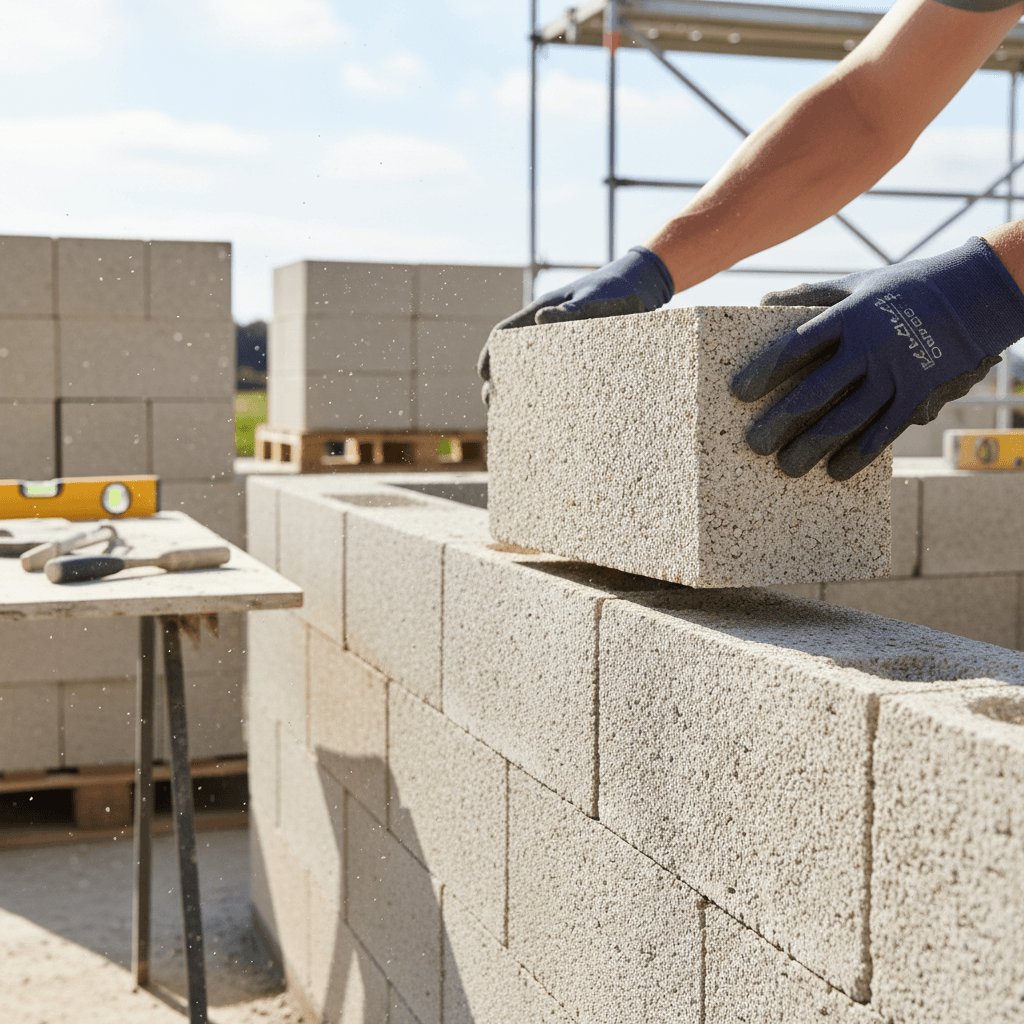
Renewabuild Great Plains is preparing to commence manufacturing of structural hempcrete blocks in Rock Valley, Iowa, with production anticipated to begin by the end of 2026. This initiative positions the company as the first in the United States to produce these specific structural hempcrete blocks, according to a report by Agweek. The development builds on earlier reports of industrial hemp infrastructure development in Iowa.
Bill Brehmer, president of Renewabuild Great Plains and a fourth-generation farmland owner, began exploring industrial hemp applications after its legalisation for cultivation. His research led him to a patented structural block design, which he identified as a high-volume market opportunity for processed hemp hurd.
The Composition and Benefits of Structural Hempcrete Blocks
Hempcrete is typically made from hemp hurd, a lime-based binder, and water. While traditional hempcrete serves as an insulation product, the blocks developed by Renewabuild Great Plains incorporate a polymer-based form that provides structural integrity. These blocks are approximately 22 inches long, 8 inches tall, and 11 inches thick, designed for efficiency in high-volume construction projects.
- Insulation and Breathability: The blocks offer a high insulation value, estimated at R-40 for a finished wall. They create a breathable wall system, which can contribute to a stable internal environment.
- Durability and Resistance: Hempcrete blocks are resistant to mold and are not attractive to termites, addressing common issues in conventional construction.
- Fire Resistance: According to Brehmer, the walls constructed with these blocks will char when exposed to fire but will not ignite, enhancing building safety.
- Non-toxic: The blocks do not off-gas volatile organic compounds (VOCs), a characteristic that can be relevant for indoor air quality compared to some traditional building materials.
The structural nature of these hempcrete blocks simplifies the building process. Brehmer notes that they can eliminate the need for an additional frame, sheathing, drywall, vapor barriers, and insulation in a typical stick-frame house. Once erected, the blocks come with a scratch coat, requiring only a limestone plaster on the interior and limestone stucco on the exterior for a finished wall. Traditional siding can also be added using furring strips.
Demonstrated Performance and Market Outlook
The technology behind these structural hempcrete blocks has been in use in Canada, where Renewabuild Field to Form has manufactured them for several years. This includes their use in six residential homes and a commercial building at Trent University in Peterborough, Ontario. These structures have demonstrated resilience, with some houses withstanding earthquakes and walls capable of enduring winds exceeding 300 miles per hour.
Renewabuild Great Plains aims to have its Iowa facility producing blocks by late 2026. In the interim, the company plans to access blocks from Canada to begin work on contracted projects, including an event center near Sioux Falls, South Dakota, expected to be completed by the end of the year.
The company’s business model involves local farmers and business people as shareholders, fostering economic development within rural communities. A single manufacturing line requires 2,000 to 3,000 acres of industrial hemp annually. Brehmer projects that the company could operate eight such lines within five years, requiring 16,000 to 24,000 acres of hemp. This demand for industrial hemp offers a value proposition for farmers, particularly when compared to current commodity prices for corn and soybeans.
Disclaimer: This article is for informational purposes only and does not constitute medical advice. Hemp Gazette does not provide medical recommendations, diagnoses, or treatment plans. Always consult a qualified healthcare practitioner before making any decisions regarding your health or any medical condition. Statements concerning the therapeutic uses of hemp, cannabis, or cannabinoid-derived products have not been evaluated by Australia’s Therapeutic Goods Administration (TGA). Medicinal cannabis products in Australia are accessed via prescription pathways under TGA regulation.