
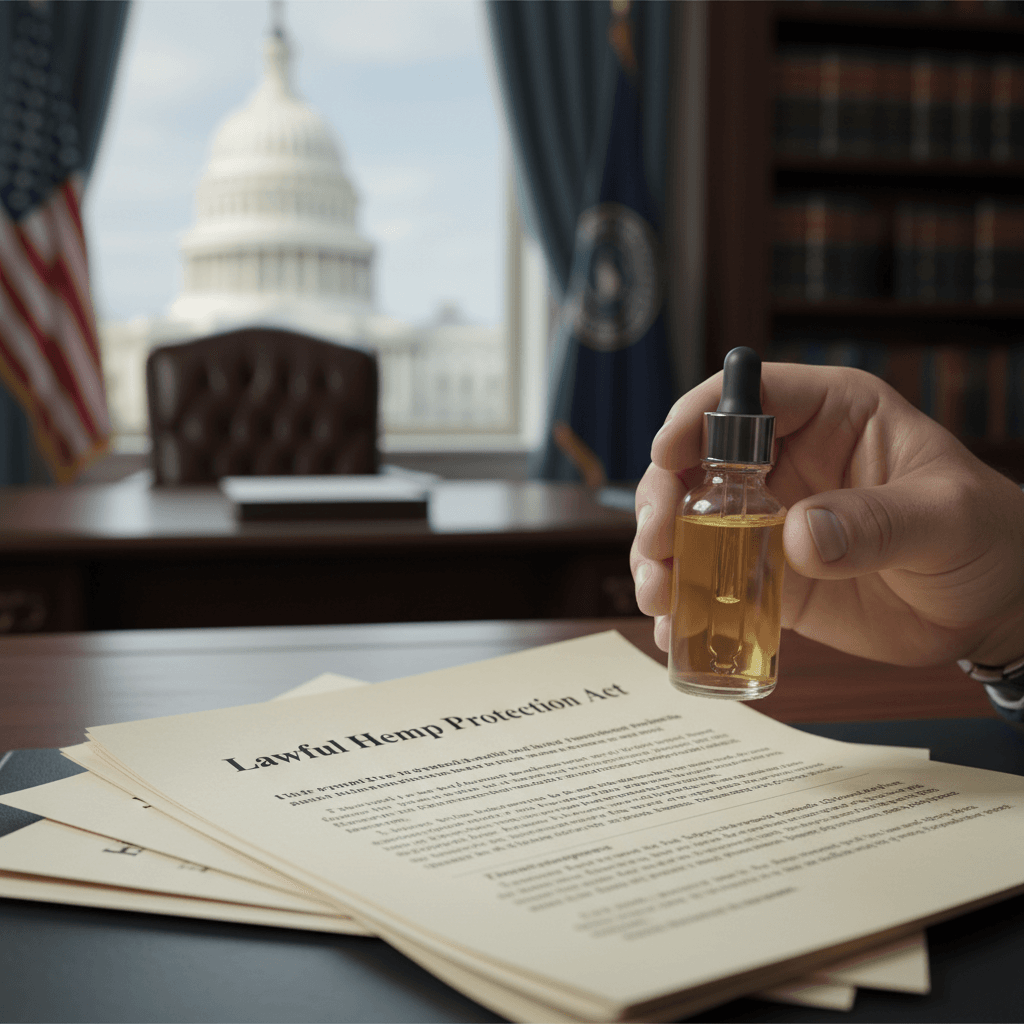
Three Republican members of the U.S. House of Representatives have filed separate amendments to large-scale agriculture legislation, H.R. 8646, the Fiscal Year Agriculture, Rural Development, Food and Drug Administration, and Related Agency appropriations bill. These proposals aim to prevent a scheduled federal ban on certain hemp THC products from taking effect in November 2026. The impending ban stems from provisions in spending legislation signed by President Donald Trump late last year, which redefined federally legal hemp to significantly narrow its scope, impacting products that were previously permissible under the 2018 Farm Bill.
Proposed Regulatory Frameworks for Hemp THC Products
Representative Andy Barr (R-KY) introduced the most comprehensive of the amendments, titled the “Lawful Hemp Protection Act.” This 25-page proposal seeks to redefine legal hemp to allow concentrations of up to 1 percent delta-9 THC on a dry-weight basis, measured on the finished consumer product rather than raw or in-process materials. The amendment explicitly excludes cannabinoids that are not naturally produced by a cannabis plant or are synthesized from non-hemp starting materials, as reported by Marijuana Moment and Cannabis Business Times.
Key provisions of Rep. Barr’s amendment include:
- Labeling Requirements: Mandating per-serving and per-package THC content, a statement for individuals over 21 years of age, and government warnings regarding pregnancy risks and driving impairment.
- Age Verification: Requiring in-person or virtual age verification for all sales, with civil penalties up to $1,000 per violation and potential permit revocation for repeated offenses.
- Taxation: Imposing a 5 percent user fee on the retail sale price of most consumable hemp products sold in interstate commerce (excluding beverages), remitted quarterly to the Treasury Department’s Alcohol and Tobacco Tax and Trade Bureau (TTB). Hemp beverages would face a federal tax of 5 cents per milligram of THC.
- Distribution System: Directing the TTB to establish a three-tier distribution system for hemp-derived beverages, modeled after alcohol regulations, within one year of enactment. This includes mandatory retailer registration and licensing.
- Adulteration Standards: Defining hemp products as “adulterated” if they exceed maximum allowable cannabinoid content, fail to comply with packaging rules, or are not exclusively derived, processed, finished, packaged, and labeled within the United States.
- State Authority: Allowing states, territories, and Indian tribes to enact more stringent hemp product laws, provided they do not interfere with the interstate passage and delivery of compliant products.
- FDA Role: Requiring the Food and Drug Administration (FDA) to publish lists of naturally occurring cannabinoids and tetrahydrocannabinol class cannabinoids within 90 days.
- Medicare Coverage: Including provisions for Medicare coverage of certain hemp-derived consumable products under specific programs, aligning with a Centers for Medicare & Medicaid Services (CMS) initiative.
- Impaired Driving: Stipulating that states risk losing federal funds if they do not address hemp-impaired driving using similar field sobriety evaluation standards and penalties as those applied to alcohol or other impairing substances.
Delay and Enforcement Prevention Efforts
Beyond Rep. Barr’s comprehensive proposal, two other Republican lawmakers have filed amendments addressing the impending ban. Representative Russell Fry (R-SC) submitted an amendment that would delay the planned recriminalization of hemp THC products for an additional two years. This is proposed by striking “365 days” and inserting “3 years” into Section 781 of the relevant agricultural spending bill. Separately, Representative James Comer (R-KY) filed a measure seeking to prevent federal officials from spending any funds to enforce Section 781, which significantly narrowed the definition of federally legal hemp. Rep. Comer has previously advocated for delays to the ban, as noted by Cannabis Business Times.
Industry and Political Landscape
The House Rules Committee is expected to decide which of the submitted amendments to H.R. 8646 will advance toward floor votes. The White House has provided feedback on Rep. Barr’s legislative efforts, with officials supporting access to appropriate full-spectrum CBD products while aiming to restrict products posing health risks. President Trump himself has called on Congress to update the law to ensure continued access to full-spectrum CBD products and to support farmers, as reported by Marijuana Moment.
Industry stakeholders and advocates are closely monitoring these developments. The Wine & Spirits Wholesalers of America (WSWA) has expressed concern that a ban would push consumers toward unregulated online channels, lacking age verification and product standards. Senator Ted Cruz (R-TX) has indicated that averting the scheduled federal recriminalization of hemp THC products this year will be an “uphill path.” As previously reported by Hemp Gazette, the industry faces significant restructuring if the ban proceeds without legislative intervention.
Disclaimer: This article is for informational purposes only and does not constitute medical advice. Hemp Gazette does not provide medical recommendations, diagnoses, or treatment plans. Always consult a qualified healthcare practitioner before making any decisions regarding your health or any medical condition. Statements concerning the therapeutic uses of hemp, cannabis, or cannabinoid-derived products have not been evaluated by Australia’s Therapeutic Goods Administration (TGA). Medicinal cannabis products in Australia are accessed via prescription pathways under TGA regulation.