
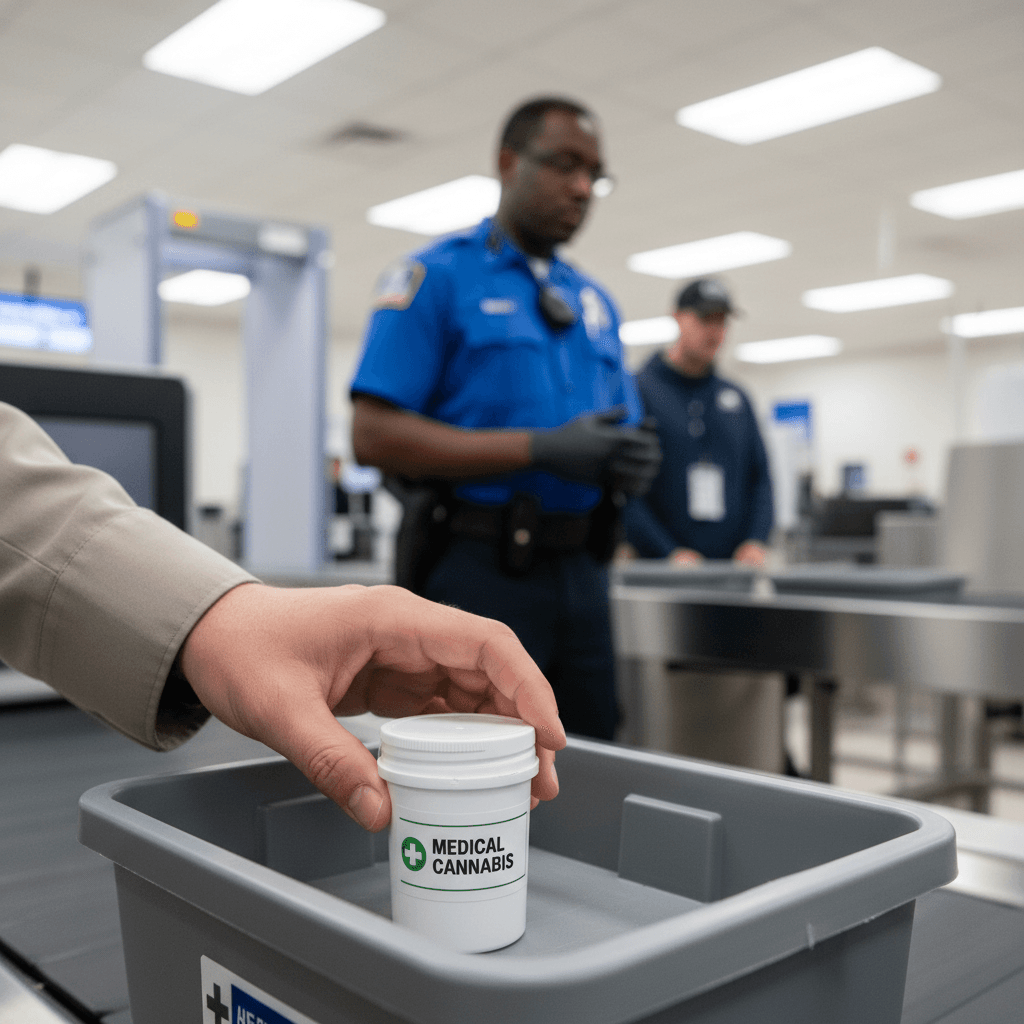
The Transportation Security Administration (TSA) has recently updated its online guidance regarding medical cannabis travel, indicating that the substance may now be permitted in both carry-on and checked luggage. This development follows the federal reclassification of certain cannabis products to Schedule III, a move that took effect nationally on April 28, 2026. However, specific operational instructions for travelers and airport security personnel remain unissued, leading to ongoing ambiguity.
Policy Shift and Regulatory Context
The TSA’s “What Can I Bring?” online tool now states that “medical marijuana” is allowed in both carry-on and checked bags, albeit “pursuant to special instructions” that have not yet been published, according to a report by GBH News. This update, observed around April 27, 2026, by The Independent, aligns with the reclassification of state-licensed medical marijuana from a Schedule I to a Schedule III drug. Acting U.S. Attorney General Todd Blanche signed the order formalizing this change on April 23, four days prior to the TSA’s website update, as reported by The Independent.
The reclassification to Schedule III signifies that medical cannabis is now considered to have a moderate to low potential for physical and psychological dependence, a departure from its previous Schedule I status, which implied no accepted medical use and a high potential for abuse. This regulatory adjustment does not federally legalize cannabis but significantly alters its oversight, offering several implications:
- It provides a degree of legitimacy to medical cannabis programs in the 40 U.S. states that have adopted them.
- State-licensed producers and distributors are now able to register with the Drug Enforcement Administration (DEA).
- It provides potential tax benefits to licensed operators.
- It eases restrictions on medical research involving cannabis.
Operational Ambiguity and Enforcement Discretion
Despite the updated online guidance, the practical implementation of the new medical cannabis travel policy remains unclear. The TSA has not issued comprehensive directives to travelers, and local TSA agents, including those represented by the union for New England’s TSA workers, had not been briefed on the policy change as of May 19, 2026, according to Mike Gazyagian, the union president, in an email to GBH News.
The agency’s stated focus remains on aviation security. The TSA website clarifies that “TSA security officers do not search for illegal drugs, but if any illegal substance or evidence of criminal activity is discovered during security screening, TSA will refer the matter to a law enforcement officer,” as noted by The New York Post. Furthermore, the final decision on whether an item is permitted through a security checkpoint rests with the individual TSA officer on duty. While lawyers have indicated that prosecution for small amounts of cannabis is rare, larger quantities could lead to serious charges, as exemplified by a case involving 75 pounds of cannabis at Miami International Airport, reported by The New York Post.
Industry and Patient Perspectives on Medical Cannabis Travel
The apparent shift in federal policy has been welcomed by patient advocacy groups. Jeremiah MacKinnon, executive director of the Massachusetts Patient Advocacy Alliance, described the moment as significant, noting that the federal government is now “recognizing medical marijuana as a medicine,” as quoted by GBH News. He suggested that while the change might not drastically alter the daily airport experience for many patients who have previously traveled with small amounts without issue, it provides reassurance against potential legal repercussions. The non-profit Medical Marijuana Policy Project has also stated that TSA agents have not actively searched for marijuana at U.S. airports for years.
This development builds on earlier coverage by Hemp Gazette regarding the federal rescheduling of medical cannabis and initial TSA updates. While the latest guidance offers a degree of federal acknowledgment for medical cannabis travel, the absence of clear, comprehensive instructions for both travelers and security personnel means that discretion at the checkpoint remains a critical factor.
Disclaimer: This article is for informational purposes only and does not constitute medical advice. Hemp Gazette does not provide medical recommendations, diagnoses, or treatment plans. Always consult a qualified healthcare practitioner before making any decisions regarding your health or any medical condition. Statements concerning the therapeutic uses of hemp, cannabis, or cannabinoid-derived products have not been evaluated by Australia’s Therapeutic Goods Administration (TGA). Medicinal cannabis products in Australia are accessed via prescription pathways under TGA regulation.