
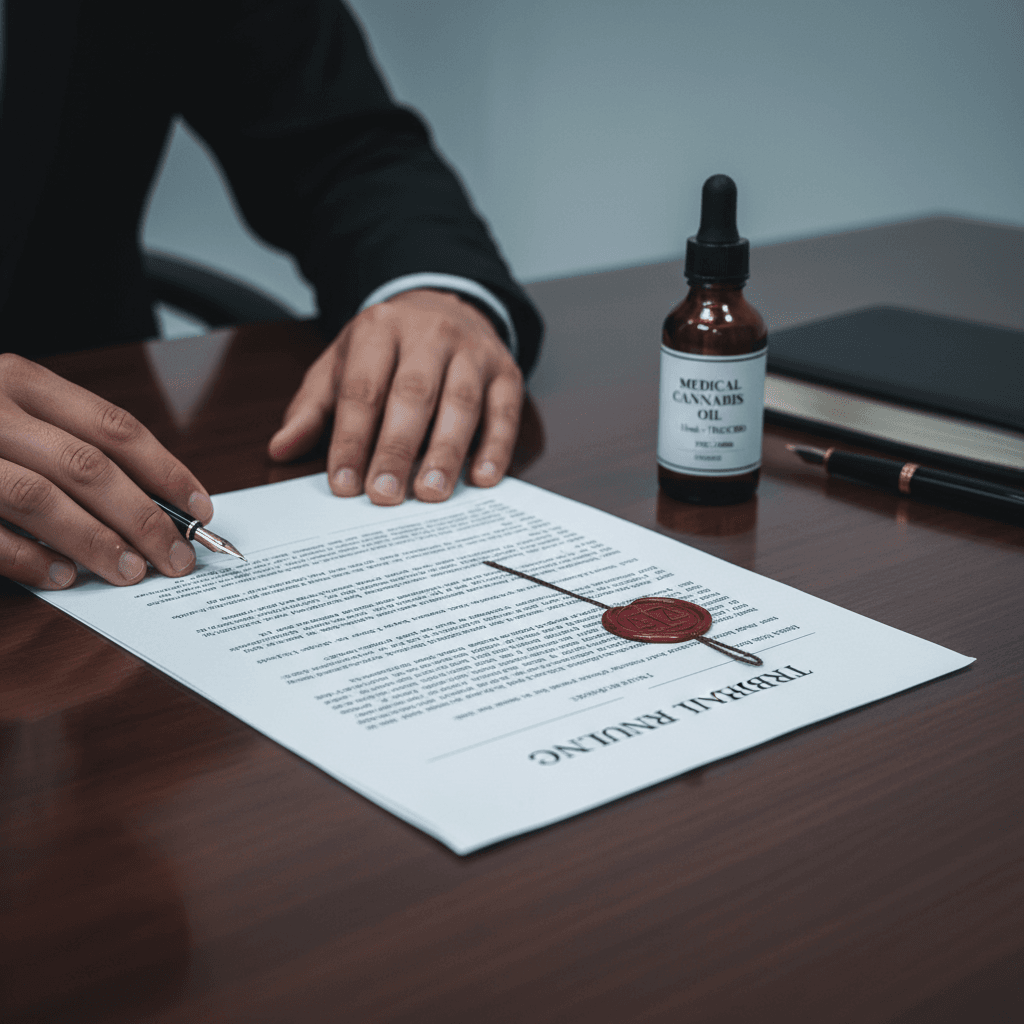
The Employment Appeal Tribunal (EAT) in the UK has remitted aspects of a disability discrimination claim involving a worker’s conditional job offer and a positive drug test for prescribed medical cannabis back to the Employment Tribunal (ET) for reconsideration. Importantly, no final determination of disability discrimination has been made. The case highlights the complexities employers face when managing individuals with legitimate medical cannabis prescriptions in safety-critical environments.
The case involves Jack Truman, who uses prescribed medical cannabis to manage chronic pain associated with haemochromatosis. In May 2022, Mr. Truman received a conditional job offer for an office-based lift planner role at Powerlines, a company involved in high-voltage transmission line construction for the railway industry. The offer was contingent on passing a drug and alcohol test conducted by Express Medicals, an occupational health provider authorised by the Rail Safety and Standards Board, as reported by People Management.
Case Background and Initial Tribunal Decision
During his medical appointment, Mr. Truman disclosed his medical cannabis prescription to the nurse and provided evidence. Network Rail’s Level 2 policy stipulated that a positive drug test could still be recorded as a ‘pass’ if there was a legitimate medical need for the detected substance quantity. The initial tribunal acknowledged that, had this policy been correctly applied, Mr. Truman’s result should have been recorded as a pass.
However, Express Medicals recorded a ‘fail’ on July 1, 2022, despite the disclosure and medical evidence. This result was uploaded to Network Rail’s Sentinel system, which manages rail worker authorisations, automatically triggering a five-year ban for Mr. Truman from undertaking any safety-critical role. An email from an Express Medicals manager on July 5, 2022, stated that “use of any substance containing THC is not permitted within the Network Rail industry on the grounds of safety, even if prescribed,” confirming the ‘fail’ outcome.
Mr. Truman subsequently brought disability discrimination claims against Powerlines and Network Rail, also alleging that Express Medicals had “instructed, caused or induced” Network Rail to discriminate against him. The original tribunal dismissed these claims, despite acknowledging that Mr. Truman had “suffered an injustice” and that the policy should have led to him passing the test.
Employment Appeal Tribunal Findings
On appeal, the EAT allowed Mr. Truman’s appeal solely on the substantial disadvantage/reasonable adjustments issue against Network Rail, remitting that specific issue to the Employment Tribunal for reconsideration. Mr. Truman’s appeal against Powerlines was dismissed.
Crucially, Express Medicals succeeded in its cross-appeal. The EAT held that it had no liability for inducing, causing or instructing any purported contravention by Network Rail. The judgment clarified that Express Medicals was not found liable for any discrimination.
Regarding the legal comparator used in the case, Mr. Truman submitted that the appropriate comparator should have been a non-disabled person who took the test and passed. However, the EAT did not adopt this submission as its finding. Instead, the judge found no error in the ET’s chosen comparator of a non-disabled worker who tested positive for a proscribed substance. The EAT identified a more nuanced issue: the tribunal had not sufficiently explained why the failure to take account of relevant medical information did not “bite harder” on Mr. Truman, given his legitimate medical need for cannabis. This specific issue regarding Network Rail was therefore remitted for reconsideration. Judge Soole concluded that Network Rail remained accountable for both the refusal to issue a Sentinel card and the imposition of the work ban.
A Network Rail spokesperson commented that the organisation’s drugs and alcohol policy is vital for safety, and that “no final determination has been made” as aspects of the case are subject to further tribunal considerations.
Implications for Employers and Policy
The EAT’s decision underscores the complexities involved in managing prospective and current employees with medical cannabis prescriptions within safety-critical industries. Legal experts have highlighted the need for employers to review their policies and practices. Natalie Parkinson, head of employment litigation at AfterAthena, noted that comparator analysis in such cases is not straightforward and may necessitate specialist advice to manage risk. She observed an increase in client inquiries regarding medical cannabis and employment, stressing that decisions should be made on a case-by-case basis, considering the reason for prescription and its relevance to the specific role.
Elaine Huttley, partner and head of employment law at Irwin Mitchell, advised businesses to review both the wording and practical application of their policies. She emphasised that policies must be non-discriminatory and applied consistently, without disadvantaging employees with protected characteristics. Sarah Goldie, HR consultant at Birketts, suggested that as medical treatments and associated regulatory guidance evolve, traditional workplace rules may require updates. She recommended that employers update drug and alcohol policies to accommodate prescribed medication where appropriate and seek occupational health advice to support individual assessments and decision-making.
Disclaimer: This article is for informational purposes only and does not constitute medical advice. Hemp Gazette does not provide medical recommendations, diagnoses, or treatment plans. Always consult a qualified healthcare practitioner before making any decisions regarding your health or any medical condition. Statements concerning the therapeutic uses of hemp, cannabis, or cannabinoid-derived products have not been evaluated by Australia’s Therapeutic Goods Administration (TGA). Medicinal cannabis products in Australia are accessed via prescription pathways under TGA regulation.