
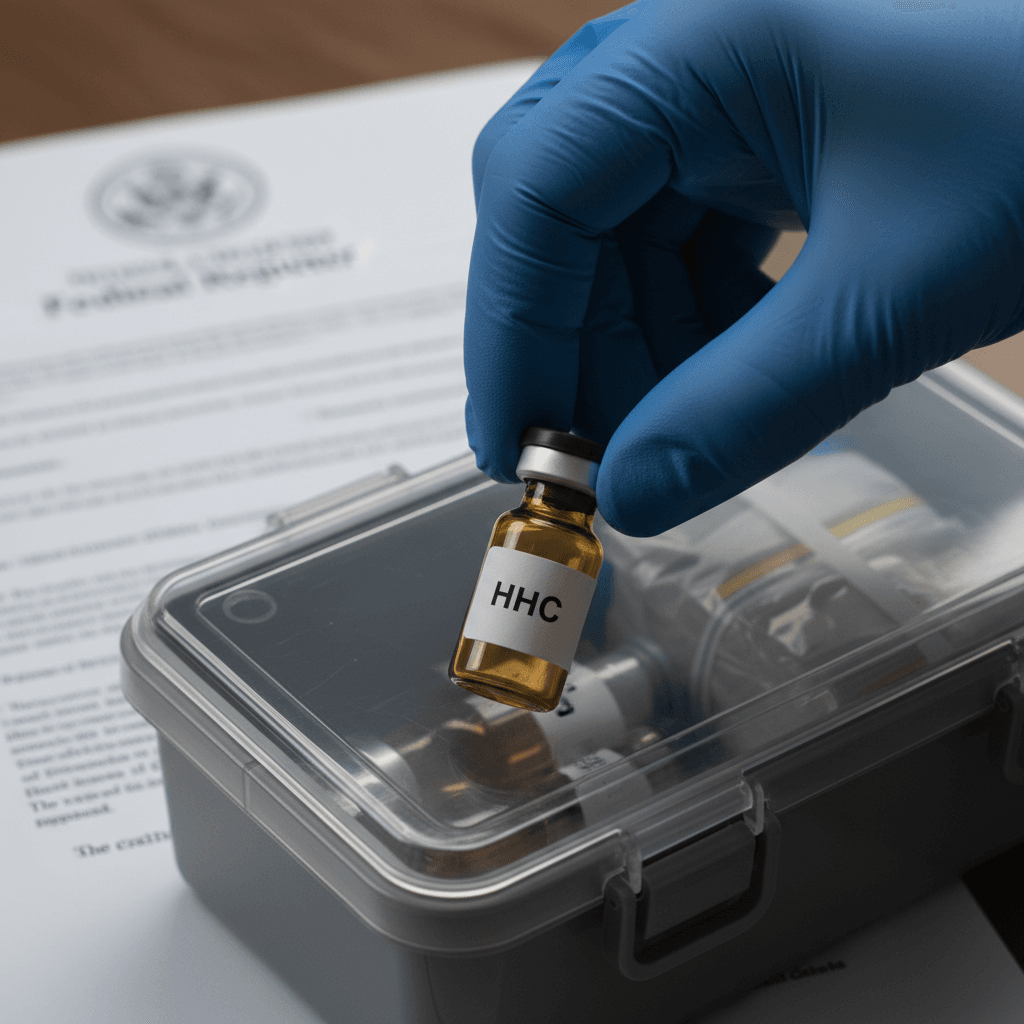
The U.S. Drug Enforcement Administration (DEA) has issued a clarification regarding the federal legality of hexahydrocannabinol (HHC), a cannabinoid produced synthetically from cannabis plant components. The agency confirmed that HHC remains a Schedule I illegal substance under the federal Controlled Substances Act (CSA) and has assigned it a unique drug code for classification purposes.
While HHC can be found in trace amounts in cannabis plants, it is primarily synthesized through the hydrogenation of cannabidiol (CBD). The DEA’s position, as outlined in a notice published in the Federal Register, is that the 2018 Farm Bill’s federal legalisation of hemp and its derivatives with less than 0.3 percent delta-9 THC applies only to naturally occurring cannabinoids, not synthetic compounds like HHC. Consequently, the agency states that hexahydrocannabinol legality does not fall under the definition of legal hemp.
DEA’s Stance on Synthetic Cannabinoids
The DEA’s notice specifies that “only tetrahydrocannabinols in or derived from the cannabis plant—not synthetic tetrahydrocannabinols—are excluded from control as ‘tetrahydrocannabinols in hemp.'” It further clarifies that “tetrahydrocannabinols produced through chemical conversion, even when hemp derived are considered synthetically produced for purposes of the CSA, do not qualify as ‘tetrahydrocannabinols in hemp’ under” the 2018 Farm Bill, according to a report by Marijuana Moment.
This is not the first instance of the DEA addressing the legal status of HHC. In a 2023 letter, Terrance Boos, chief of the DEA’s Drug and Chemical Evaluation Section, stated that HHC “does not occur naturally in the cannabis plant and can only be obtained synthetically, and therefore does not fall under the definition of hemp.” The recent Federal Register filing, signed by DEA Administrator Terrance Cole, reiterates that this action “does not affect the continuing status of hexahydrocannabinol as a schedule I controlled substance in any way.”
The administrative action establishes a separate, specific listing for hexahydrocannabinol in Schedule I of the CSA and assigns a DEA drug code. This measure will enable the DEA to establish an aggregate production quota and grant individual manufacturing and procurement quotas to DEA-registered manufacturers of HHC, who previously operated under the drug code for tetrahydrocannabinols.
International Context and Industry Implications
The DEA notice references a move by an international drug control body last year to add HHC to Schedule II of the United Nations Convention on Psychotropic Substances of 1971. As previously reported by Hemp Gazette, the Commission on Narcotic Drugs (CND) took this action, though the U.S. was the sole country to abstain from the vote. The U.S. Department of Health and Human Services (HHS) has concurred with the direct listing and drug code assignment of hexahydrocannabinol in the CSA.
Despite the DEA’s consistent interpretation, some federal appeals courts have challenged the agency’s understanding of what constitutes a legal cannabinoid under the Farm Bill. This ongoing legal ambiguity creates a complex regulatory environment for operators in the cannabis industry.
Broader Regulatory Changes
Separately, the federal definition of legal hemp in the U.S. is slated for a change in November, under provisions of a large-scale spending bill signed by President Donald Trump. Unless altered or delayed, this will limit legal hemp products to those containing up to 0.4 milligrams of total THC per container after November 12. This development, alongside the DEA’s clarification on hexahydrocannabinol legality, indicates a tightening regulatory landscape for hemp-derived products.
Disclaimer: This article is for informational purposes only and does not constitute medical advice. Hemp Gazette does not provide medical recommendations, diagnoses, or treatment plans. Always consult a qualified healthcare practitioner before making any decisions regarding your health or any medical condition. Statements concerning the therapeutic uses of hemp, cannabis, or cannabinoid-derived products have not been evaluated by Australia’s Therapeutic Goods Administration (TGA). Medicinal cannabis products in Australia are accessed via prescription pathways under TGA regulation.