
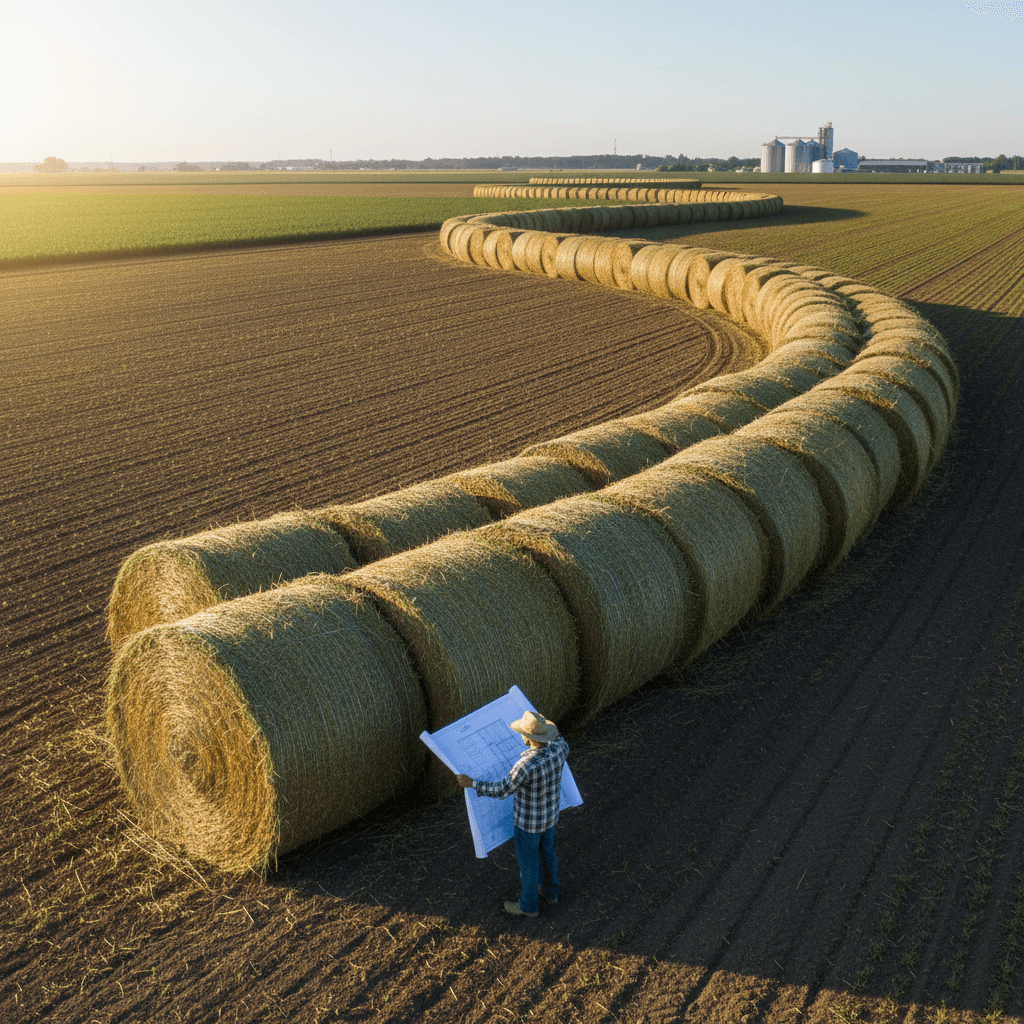
A significant volume of industrial hemp fiber, harvested by farmer Steve Groff in Southern Lancaster County, Pennsylvania, currently sits in large bales and silage bags, awaiting the development of local processing infrastructure. Groff’s farm in Holtwood is home to what he calls a “Great Wall of Hemp,” a stack of 1,200 round bales from his 2023 fiber hemp crop, extending approximately two-tenths of a mile. This visual display, along with his 2022 crop stored in silage bags, represents over a million pounds of hemp fiber waiting for facilities to transform it into usable products.
The Need for Industrial Hemp Processing
The accumulation of this substantial hemp harvest underscores a persistent challenge in the U.S. industrial hemp sector: the gap between cultivation capacity and processing capability. According to a recent episode of the Lancaster Farming Industrial Hemp Podcast, Groff views his stored hemp as a metaphor for “broken promises and stalled contracts” that have characterized the industry since the 2018 Farm Bill. Despite eight years passing since the bill’s passage, the necessary infrastructure for large-scale industrial hemp processing in Pennsylvania remains largely unbuilt.
Groff notes that blueprints for a 16,000-square-foot processing facility are fully permitted, yet funding has not materialized to begin construction. This situation highlights the ongoing need for investment in facilities that can decorticate, separate, and refine hemp fiber and hurd into materials for various applications, from construction to textiles and bioplastics.
Advancing Agronomy and Equipment
Despite the processing bottleneck, Groff continues to innovate in cultivation. At his Cedar Meadow Farm, a four-acre research plot is dedicated to testing five biological seed treatments against a control, replicated four times. This experiment involves tracking 2,000 individual hemp seedlings with colored flags from emergence to harvest, aiming to understand and mitigate “phantom yield loss”—the discrepancy between expected and actual plant populations in the field. Addressing this issue could significantly improve yield predictability and farmer profitability.
Further agricultural innovation includes a four-inch precision hemp planter currently under construction. Designed by farmer-inventor Charlie Martin, this planter aims to achieve uniform stands by singulating seeds, a practice common in China and Europe but less so in the United States. This project received support from a Pennsylvania Department of Agriculture innovation grant, highlighting efforts to bring advanced planting technology to the U.S. hemp industry. Additionally, an update on the Green Decorticator indicates it has reached the CAD-drawing stage and is scheduled for commercial testing this summer. This machine is designed to produce long fiber, specifically targeting high-end textile markets, which could open new revenue streams for growers.
Beyond the Field: Utilisation and Policy
While awaiting dedicated industrial hemp processing, Groff has found a temporary use for some of his 2022 hemp crop. He is utilizing it as mulch for over 12,000 heirloom tomato plants grown in high tunnels. This practical application, while beneficial for soil health, moisture retention, and weed suppression (as detailed by resources like the Rodale Institute), is a stopgap measure for a crop with broader industrial potential. The over a million pounds of hemp fiber currently stored could otherwise be processed into a range of sustainable products, including insulation for construction, pulp for paper, advanced biocomposites for automotive or aerospace, and various bioplastics, reducing reliance on less sustainable materials.
The broader policy landscape continues to evolve, offering potential for future growth. The U.S. House of Representatives recently passed the 2024 Farm Bill, which includes provisions to formally separate industrial hemp from cannabinoid hemp and aims to tighten regulations on intoxicating products. This legislative step, as reported by Hemp Today, seeks to clarify the legal framework for industrial hemp, potentially paving the way for more stable market conditions and encouraging investment in infrastructure. The Senate version of the bill is still pending, but such legislative clarity is often a prerequisite for significant industrial development.
Steve Groff remains optimistic about the future of the plant and its capabilities. He believes that with a supportive Farm Bill and the eventual establishment of robust industrial hemp processing facilities, the industry can fulfill its promise and contribute significantly to sustainable manufacturing and agriculture, moving beyond the current challenges of unutilized harvests.
Disclaimer: This article is for informational purposes only and does not constitute medical advice. Hemp Gazette does not provide medical recommendations, diagnoses, or treatment plans. Always consult a qualified healthcare practitioner before making any decisions regarding your health or any medical condition. Statements concerning the therapeutic uses of hemp, cannabis, or cannabinoid-derived products have not been evaluated by Australia’s Therapeutic Goods Administration (TGA). Medicinal cannabis products in Australia are accessed via prescription pathways under TGA regulation.