
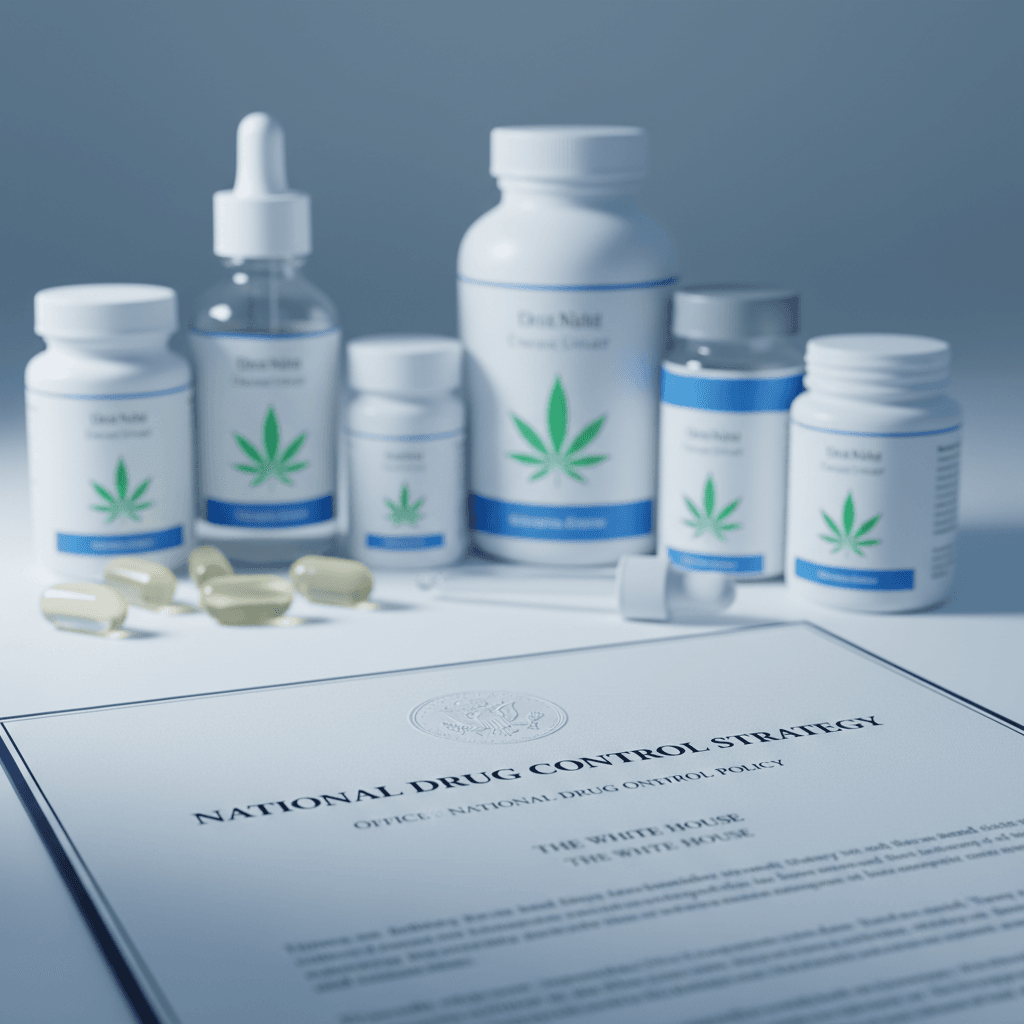
The White House Office of National Drug Control Policy (ONDCP) has released a new National Drug Control Strategy, outlining concerns regarding “high-potency” marijuana and affirming the forthcoming federal recriminalization of certain hemp THC products. The 195-page document, published weeks after the administration announced plans to reschedule marijuana, focuses on perceived health effects and marketing practices of cannabis, while also detailing changes to the legal status of hemp-derived cannabinoids.
White House Concerns on High-Potency Marijuana
The ONDCP strategy expresses alarm over the commercial marketing of addictive substances, stating that industries selling marijuana have adopted strategies similar to historical tobacco targeting of young audiences. According to Marijuana Moment, the document asserts that “marijuana products are today of unprecedented high potency, are often highly processed, aggressively advertised, and often packaged to appeal to minors.”
- Health Risks: The strategy cites “convergent evidence from multiple sources” suggesting that cannabis exposure increases the risk of psychosis, and that preventing marijuana use could reduce the prevalence of psychosis, cannabis use disorder, and other consequences. It also links “high-potency marijuana” to drug-induced psychosis and suicide in young adults.
- Addiction and Withdrawal: The ONDCP notes that marijuana addiction, or cannabis use disorder, affected 20.6 million, or 7.1 percent, of Americans over the age of 12 in 2024, and is the primary reason for addiction treatment for those under 20. It highlights that withdrawal may cause insomnia and anxiety, and that there are currently no FDA-approved medications for marijuana addiction or withdrawal.
- Other Health Concerns: The document warns consumers about risks to heart health, cognition, and cancer. It points to a California study showing an 1,800% increase in cannabis-associated emergency department visits for seniors over 65 from 2005 to 2019. Further concerns include exposure to heavy metals, pesticides, and fungal pathogens that can accumulate in the plant and cause serious infections in immunocompromised individuals.
- Illicit Trade: The strategy also raises alarm about transnational criminal organizations and domestic gangs exploiting state-level marijuana laws to establish large-scale illicit cultivation and interstate distribution networks, particularly citing Chinese-linked groups in Oklahoma.
Impending Federal Hemp THC Ban
The ONDCP document discusses the “hemp loophole closure” provision within the Agriculture, Rural Development, Food and Drug Administration, and Related Agencies Act funding bill for fiscal year (FY) 2026. This legislation, signed by President Donald Trump, redefines hemp such that only products containing 0.4 milligrams of total THC per container will remain federally legal after November 12, 2026.
Psychoactive derivatives of hemp, such as delta-8 THC, delta-10 THC, THC-O-acetate, and THCP, which are often produced in laboratories, will be considered Schedule I controlled substances under the new Hemp Restriction regulations. The ONDCP states these products are often unregulated, can contain dangerous chemicals, and have been linked to cases of psychosis and suicide attempts. Law enforcement is expected to “intensify efforts to prosecute the illicit production and distribution of dangerous substances originating within the United States,” including targeting retail operations unlawfully marketing harmful products.
Industry Response and Legislative Efforts
The U.S. House of Representatives recently passed H.R.7567, the Farm, Food, and National Security Act of 2026, without including provisions to alter or delay the impending federal hemp THC ban. The Wine & Spirits Wholesalers of America (WSWA) characterized this as a “missed opportunity,” arguing that a ban would push consumers toward unregulated online channels. As reported by Marijuana Moment, WSWA’s Executive Vice President of Government Affairs, Dawson Hobbs, stated, “We urge the Senate to act before November 2026 to replace this ban with a durable federal framework that actually protects consumers.” WSWA advocates for a regulatory approach similar to alcohol, including federal licensure, taxation, and independent testing.
President Trump has called on Congress to update the law to ensure continued access to full-spectrum CBD products while preserving the intent to restrict products posing health risks. White House officials have provided legislative text suggestions to Representative Andy Barr (R-KY) to address the statutory definition of final hemp-derived cannabinoid products. Separately, the Hemp Safety Enforcement Act, introduced by Senators Rand Paul (R-KY) and Amy Klobuchar (D-MN), aims to allow states to opt out of the federal recriminalization of hemp THC products.
Meanwhile, a U.S. Department of Agriculture report indicated that farmers grew US$750 million worth of hemp crops in 2025, a 64 percent increase from the prior year. The Trump administration also launched an initiative to cover up to US$500 worth of hemp-derived products annually for eligible Medicare patients, a program that has faced legal challenges from anti-marijuana organizations.
Disclaimer: This article is for informational purposes only and does not constitute medical advice. Hemp Gazette does not provide medical recommendations, diagnoses, or treatment plans. Always consult a qualified healthcare practitioner before making any decisions regarding your health or any medical condition. Statements concerning the therapeutic uses of hemp, cannabis, or cannabinoid-derived products have not been evaluated by Australia’s Therapeutic Goods Administration (TGA). Medicinal cannabis products in Australia are accessed via prescription pathways under TGA regulation.