
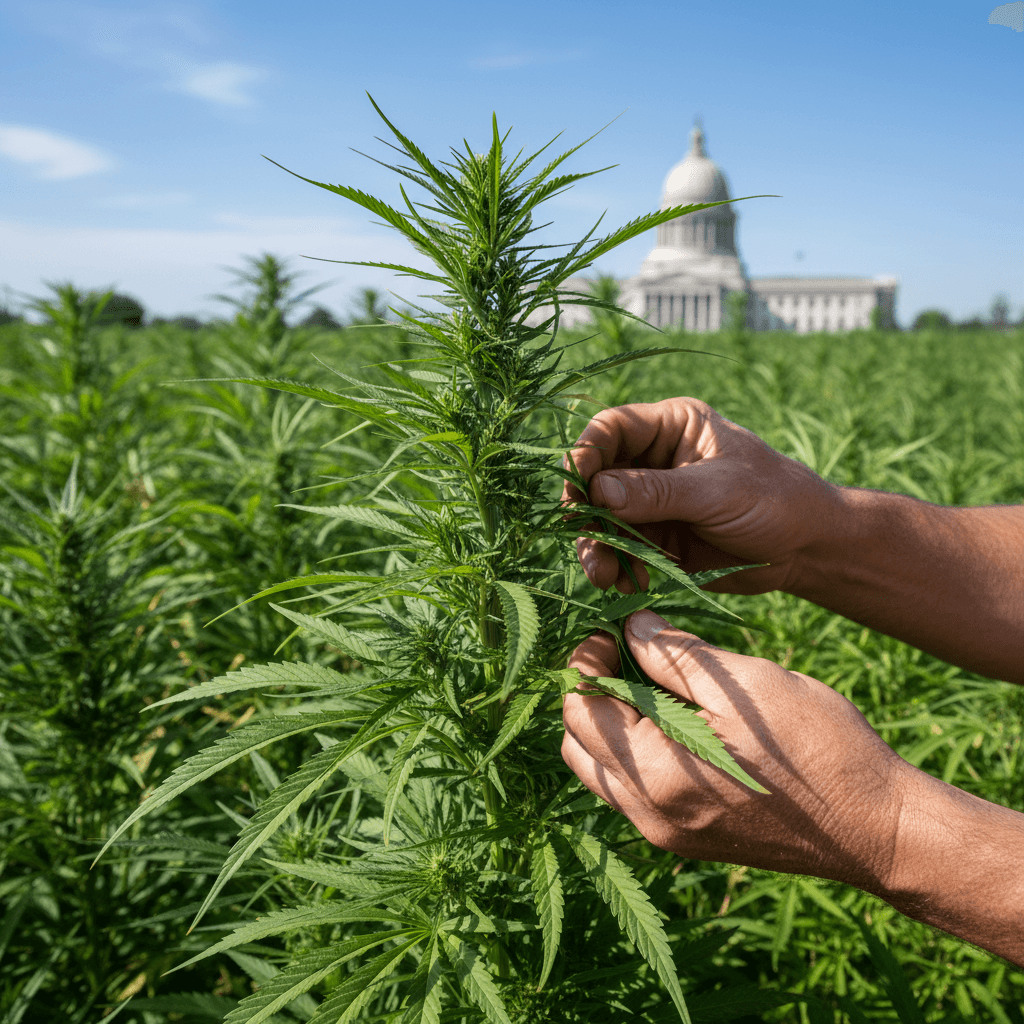
The U.S. House of Representatives has passed significant agriculture legislation, H.R.7567, the Farm, Food, and National Security Act of 2026, which includes several provisions aimed at reducing regulatory burdens for producers of industrial hemp. The bill passed with a vote of 224-200. However, the legislation notably omits any language that would delay or alter the federal recriminalization of hemp-derived THC products, which is scheduled to take effect later this year, as reported by Marijuana Moment.
Legislative Action on Industrial Hemp
The newly passed Farm Bill contains several sections directly impacting cannabis cultivated for industrial purposes, such as fiber and grain. These amendments to subtitle G of the Agricultural Marketing Act of 1946 are designed to streamline regulatory processes for industrial hemp production. Key changes outlined by House Agriculture Committee staff include:
- Requiring State and Tribal plans to include procedures for hemp producers to designate their type of production.
- Allowing State and Tribal plans to incorporate visual inspections, performance-based sampling, or certified seed in developing sampling plans for industrial hemp.
- Permitting the elimination of the 10-year period of ineligibility for industrial hemp producers with a felony related to a controlled substance.
- Mandating documentation during inspections to demonstrate clear intent to produce industrial hemp, particularly for plans reducing or eliminating sampling or testing.
- Requiring States or Tribes to report producers who violate their plans by producing crops inconsistent with the industrial hemp designation to the Attorney General and applicable law enforcement.
- Banning any person who knowingly produced a crop inconsistent with the industrial hemp designation from obtaining a hemp license for five years.
The legislation also mandates the Secretary of Agriculture to establish a process for the U.S. Department of Agriculture (USDA) to issue certificates of accreditation to laboratories for hemp testing. The Committee report emphasizes continued Congressional support for the industrial hemp industry and maintains the statutory bifurcation of industrial hemp from hemp-derived cannabinoid final form products, as established through the Agriculture, Rural Development, Food and Drug Administration, and Related Agencies Appropriations Act, 2026. This framework recognizes multiple primary agricultural outputs of the hemp plant, including fiber, grain, and non-cannabinoid essential oils, aromatic compounds, and terpenes, provided any cannabinoid components meet the definition of ‘hemp’ as defined by Pub. L. 119-37.
Unaddressed Hemp-Derived THC Product Regulations
Despite the advancements for industrial hemp, bipartisan efforts to address the impending federal recriminalization of hemp-derived THC products were unsuccessful. Under legislation signed by President Donald Trump late last year, the definition of hemp will change on November 12, making only products with 0.4 milligrams of total THC per container legal. This redefinition supersedes the 2018 Farm Bill’s provision that federally legalized hemp derivatives with less than 0.3 percent delta-9 THC on a dry-weight basis.
Amendments filed by lawmakers, including Rep. James Comer (R-KY), Rep. Kelly Morrison (D-MN), Rep. Ilhan Omar (D-MN), and Rep. Morgan Griffith (R-VA), sought to delay this ban until November 2027. Rep. Comer stated that his amendment aimed to “protect American farmers” and “support the thousands of jobs in the hemp industry and people who use and rely on these products,” arguing that Congress needed more time to develop a comprehensive regulatory solution. However, these proposals were withdrawn for undisclosed reasons. Conversely, an amendment by Rep. Mary Miller (R-IL) to accelerate the ban was not advanced by the House Rules Committee for floor consideration, as detailed by Marijuana Moment.
Broader Regulatory Landscape and Market Developments
The Senate is expected to consider its own version of the Farm Bill in the coming weeks and months, where hemp industry advocates hope for action to avert the scheduled THC product ban. Concurrently, White House officials, Vince Haley, director of the White House Domestic Policy Council, and James Braid, assistant to the president for legislative affairs, have provided feedback to Rep. Andy Barr (R-KY) on pending legislation to create a regulatory framework for hemp. Their suggestions aim to preserve access to appropriate full-spectrum CBD products while restricting those posing health risks, building on an executive order signed by President Trump in December seeking to protect CBD access, according to reports.
President Trump has publicly urged Congress to update the law to ensure continued access to full-spectrum CBD products and support farmers. Other bipartisan hemp reform bills are also pending, such as the Hemp Safety Enforcement Act, introduced by Sens. Rand Paul (R-KY), Amy Klobuchar (D-MN), and initially Joni Ernst (R-IA), which would allow states to opt out of the federal recriminalization of hemp THC products. Ernst later withdrew her name as a cosponsor of the legislation.
Economic Impact and Medicare Coverage
The economic impact of the hemp industry continues to grow, with a USDA report indicating that U.S. farmers cultivated $750 million worth of hemp crops in 2025, representing a 64 percent increase from the previous year. In a significant development for patient access, the Trump administration launched an initiative through the Centers for Medicare & Medicaid Services (CMS) to cover up to $500 worth of hemp-derived products annually for eligible Medicare patients. This program primarily focuses on CBD but permits a specified amount of THC in products. While anti-marijuana organizations have filed a lawsuit against this Medicare hemp coverage policy, lawyers for Health and Human Services Secretary Robert F. Kennedy Jr. and CMS Director Mehmet Oz have moved to dismiss the case. The Food and Drug Administration (FDA) has also issued guidance clarifying its intent not to interfere with the implementation of the Medicare hemp-derived products coverage plan, and CMS separately finalized a rule allowing coverage of some hemp products through Medicare Advantage plans.
Market expansion for hemp-derived products is also evident in the retail sector, with some major retailers expanding their participation in the hemp-derived THC beverage market. For instance, following a pilot program in 10 Minnesota stores, Target obtained licenses from Minnesota regulators to sell lower-potency hemp edible products, including THC drinks, across all 72 of its stores in the state, as reported by Marijuana Moment.
Disclaimer: This article is for informational purposes only and does not constitute medical advice. Hemp Gazette does not provide medical recommendations, diagnoses, or treatment plans. Always consult a qualified healthcare practitioner before making any decisions regarding your health or any medical condition. Statements concerning the therapeutic uses of hemp, cannabis, or cannabinoid-derived products have not been evaluated by Australia’s Therapeutic Goods Administration (TGA). Medicinal cannabis products in Australia are accessed via prescription pathways under TGA regulation.