The European hemp industry continues to navigate a complex and often contradictory regulatory landscape, facing significant hurdles from member state governments despite established European Union law. This dynamic has led to substantial economic disruption and legal battles for businesses operating within the sector. A notable instance occurred in April 2025, when the Italian government utilised emergency constitutional powers to reclassify non-intoxicating hemp as a narcotic, irrespective of its tetrahydrocannabinol (THC) content. This measure, which took effect in June 2025 without parliamentary debate or a transition period, severely impacted an industry valued at hundreds of millions of euros annually and employing approximately 15,000 individuals directly, as reported by Business of Cannabis.
Regulatory Challenges Facing the European Hemp Industry
The Italian reclassification was followed by a secondary ban on CBD oils, further pressuring an already beleaguered sector. Italian hemp industry associations, supported by international legal counsel, promptly appealed to the European Commission, alleging a breach of international law. While the EC reviewed the complaints, it did not initiate formal infringement proceedings. The matter was eventually referred to the Court of Justice of the European Union (CJEU) by Italy’s Council of State, the country’s highest administrative court, more than 17 months after the initial industry alarm and seven months post-ban. This referral aims to definitively determine whether the Italian government’s actions violated EU law, and whether member states possess the authority to ban hemp.
Similar regulatory pressures are evident across the EU. Countries like Ireland, Greece, and Germany have implemented various measures to restrict the hemp industry, often leading to asset seizures and financial ruin for businesses, despite the non-intoxicating nature of compliant hemp products.
The EU Legal Framework and Member State Divergence
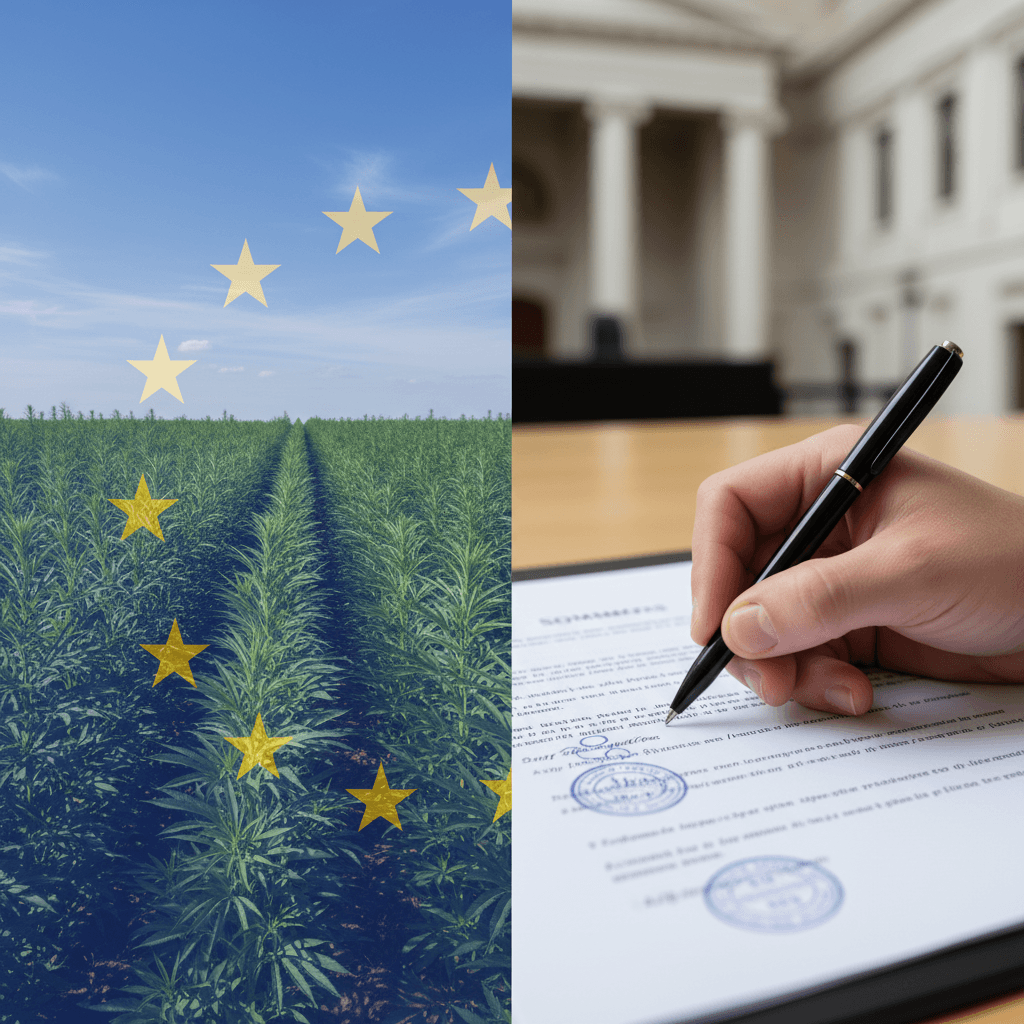
Under European Union law, Cannabis sativa L. with a THC content of 0.3% or below is recognised as a legally cultivated agricultural crop. Farmers across the continent grow it for fibre, food, cosmetics, and construction materials, qualifying for area-based direct payments under the Common Agricultural Policy. The legal status of hemp-derived products, including CBD oils, extracts, and flower, was seemingly settled at the highest judicial level in November 2020 with the landmark Kanavape case (C-663/18). The CJEU ruled that CBD is not a narcotic substance and that member states cannot prohibit the marketing of CBD products lawfully produced in another member state without clear, scientifically substantiated evidence of a genuine public health risk. This ruling remains binding on all 27 member states.
Despite this clear precedent, the practical application of EU law remains inconsistent. Kai-Friedrich Niermann, a prominent European cannabis lawyer and legal adviser to the European Industrial Hemp Association, described the situation to Business of Cannabis as: “The EU hemp framework is a complete mess.” Germany, for instance, despite having a relatively liberal cannabis framework, has seen its hemp businesses face persistent enforcement issues under a domestic ‘intoxication clause’. This clause, interpreted by Germany’s Federal Court of Justice in 2020, suggested that theoretical intoxication could occur from 15 grams of industrial hemp in a single pastry, leading to the disappearance of hemp leaf tea from supermarket shelves. Member states frequently invoke Article 36 of the Treaty on the Functioning of the European Union (TFEU), the EU’s public health derogation, to justify restrictions, framing them as proportionate responses to perceived health risks.
Key Judicial Rulings Upholding Hemp Legality
A growing body of case law demonstrates that when government restrictions on hemp are challenged in independent courts, they frequently fail to withstand scrutiny. Significant rulings include:
- CJEU, November 2020 — Kanavape, C-663/18 (France): Confirmed CBD is not a narcotic and member states require scientific evidence for marketing bans.
- CJEU, October 2024 — Biohemp Concept (Romania): Established that member states may only restrict hemp cultivation if proportionate, necessary for public health, and without less restrictive alternatives.
- Italy, February 2023, October 2023, September and October 2024 (TAR Lazio): Italy’s Regional Administrative Court annulled or suspended Health Ministry decrees restricting hemp to seeds and stems, and banning oral CBD, citing a lack of supporting scientific evidence. An independent expert report by Professor Costantino Ciallella confirmed CBD’s lack of psychophysical dependence and psychoactive effects.
- France, January 2022 (Council of State): Suspended a ban on CBD flowers within weeks, finding “serious doubt about the legality of this general and absolute prohibition measure because of its disproportionate nature.”
- UK, 2022 (Court of Appeal, Uncle Herb): Upheld the acquittal of hemp flower retailers, confirming compliant hemp flower should not be considered a narcotic (under pre-Brexit EU free movement law).
- Italy, March 2026 (Court of Cassation, Sassari): Italy’s Supreme Court ruled that the mere presence of hemp flower is insufficient for a criminal offence; actual intoxicating effect must be demonstrated.
- Italy, multiple courts, 2025-2026 (CSI Article 18 Observatory): Documented 21 cases where Italian courts returned seized hemp products, dismissed charges, and issued acquittals based on the lack of proven intoxicating effect.
- Germany, April 2026 (Amberg District Court): Acquitted a defendant carrying compliant industrial hemp, rejecting the Federal Court of Justice’s intoxication clause interpretation in light of Germany’s new Cannabis Act.
- EU, October 2025 (SCCS preliminary opinion on CBD in cosmetics): The Scientific Committee on Consumer Safety found CBD safe for use in cosmetic products at defined concentrations, rejecting France’s proposal to classify it as a reprotoxic substance.
Prospects for Legislative Reform
While the judicial system has provided some recourse, the financial and time-consuming burden of legal proceedings on businesses remains significant. However, there are emerging reasons for optimism at the legislative level. In July 2025, the European Commission published COM(2025) 553, a proposed reform of the Common Agricultural Policy as part of the 2028-2034 Multiannual Financial Framework. This proposal explicitly seeks to authorise the production and marketing of all parts of the hemp plant across the EU. Furthermore, in September 2025, the European Parliament’s Agriculture Committee endorsed the inclusion of flowers, leaves, and extracts as licit agricultural products and advocated for a single harmonised THC ceiling of 0.5% across member states.
Should these legislative changes be enacted, the Commission would gain stronger tools to pursue infringement proceedings against member states maintaining incompatible restrictions. This would provide the European hemp industry with a positive legislative basis in court, moving beyond solely relying on defensive arguments against Kanavape violations. However, COM(2025) 553 is not expected to become law before 2027, and the trilogue negotiations between the Commission, Parliament, and Council present their own risks. As Niermann cautions, even a strengthened legislative framework might not end the challenges, as member states could still invoke Article 36 TFEU, potentially leading to further judicial loops.
The upcoming CJEU ruling on Italy’s referral, anticipated no earlier than late 2026, could be binding on all 27 member states, offering an immediate basis for operators in other countries to challenge domestic restrictions and potentially bringing much-needed clarity and stability to the European hemp industry.
Disclaimer: This article is for informational purposes only and does not constitute medical advice. Hemp Gazette does not provide medical recommendations, diagnoses, or treatment plans. Always consult a qualified healthcare practitioner before making any decisions regarding your health or any medical condition. Statements concerning the therapeutic uses of hemp, cannabis, or cannabinoid-derived products have not been evaluated by Australia’s Therapeutic Goods Administration (TGA). Medicinal cannabis products in Australia are accessed via prescription pathways under TGA regulation.