
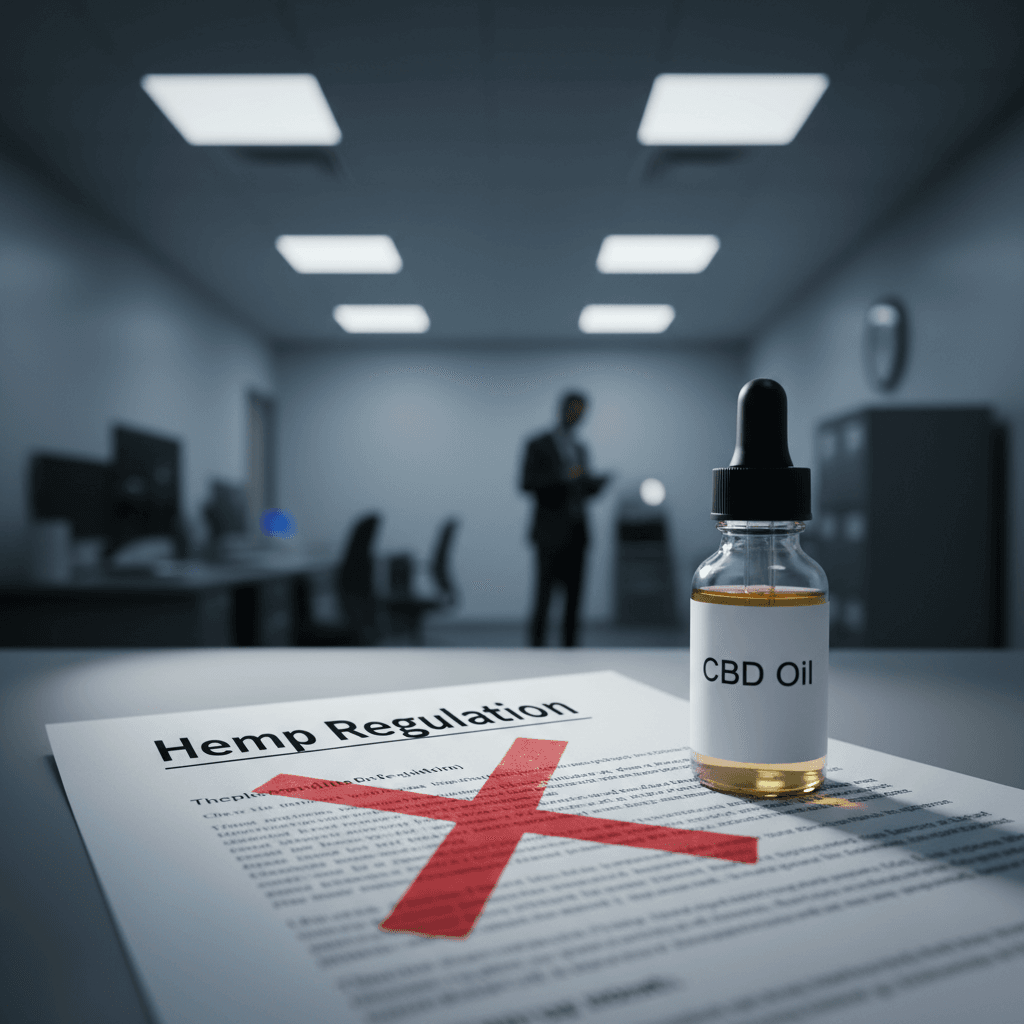
A federal hemp ban, passed by the US Congress in November 2025 and slated to take effect on November 12, 2026, poses significant regulatory and commercial challenges for the hemp-derived cannabinoid market. This legislative change could reclassify a broad spectrum of non-intoxicating CBD products as federally illegal, potentially undermining a new Centers for Medicare and Medicaid Services (CMS) pilot program designed to reimburse patients for hemp-derived products.
Regulatory Redefinition and Market Impact
The impending hemp ban introduces a stricter definition for legal hemp products compared to the 2018 Farm Bill. Under the 2018 Farm Bill, hemp was defined as any cannabis product containing less than 0.3% delta-9 tetrahydrocannabinol (THC). The new ban, however, stipulates that all products containing more than 0.4mg of any form of THC will become federally illegal.
Jonathan Miller of the US Hemp Roundtable stated that this redefinition would effectively criminalize the vast majority of hemp products, including most non-intoxicating CBD products. This shift could necessitate significant adjustments for manufacturers and distributors, impacting product formulations and market availability.
Implications for the CMS Pilot Program
The Centers for Medicare and Medicaid Services recently initiated a pilot program to reimburse certain Medicare and Medicaid recipients for up to US$500 worth of hemp-derived products annually. The program aims to evaluate whether these products can contribute to reducing other health-related costs for patients. However, the program’s definition of hemp aligns with the 2018 Farm Bill, creating a direct conflict with the forthcoming federal ban.
A group of advocates, including the Drug Free America Foundation and Cannabis Industry Victims Educating Litigators, filed a lawsuit against Health Secretary Robert F. Kennedy Jr. and CMS Administrator Mehmet Oz, alleging that the program promoted substances that may soon be federally illegal without proper administrative procedure. The court denied the lawsuit’s attempt to block the program.
Legislative Efforts and Industry Advocacy
Lawmakers and industry stakeholders have been actively pursuing legislative avenues to either delay or replace the impending hemp ban with a more comprehensive regulatory framework. Efforts include:
- Cannabinoid Safety and Regulation Act: In December 2025, Oregon Senator Ron Wyden re-introduced this act, which proposes to replace the ban with a regulatory structure designed to help ensure hemp products are safe and free of contaminants.
- Two-Year Delay Bill: Indiana Representative Jim Baird introduced a bill in January 2026 that would delay the implementation of the hemp ban for two years, providing the industry and regulators more time to adapt.
Jonathan Miller attributed the lack of progress on these bills to political polarization within Congress. Former President Trump has also publicly called for Congress to update the law to help ensure continued access to full-spectrum CBD products.
Inesa Ponomariovaite, owner of Nesa’s Hemp, has engaged with members of Congress to advocate for regulation. She noted that during her meetings, she often had to educate senators on the endocannabinoid system, highlighting a knowledge gap among policymakers regarding the biological interactions of cannabinoids. Ponomariovaite suggested that products containing a wide array of cannabinoids may offer stronger effects than isolated CBD, which might become the only legal option if the ban proceeds.
Quality Control and Future Outlook
Industry advocates, including Ponomariovaite, argue that regulatory focus should be on product contamination rather than the chemical composition of the cannabis plant itself. Hemp’s natural ability to absorb toxins from the soil means that quality controls are crucial for extracts. A Forbes Health investigation recently identified mold, yeast, and fungicide in some popular CBD products, underscoring the need for universal safety standards.
While some hemp companies implement rigorous lab testing, and certain states mandate it, comprehensive quality controls are not uniformly applied across the industry. Legislation such as the Cannabinoid Safety and Regulation Act would enable the Food and Drug Administration (FDA) to regulate hemp products, potentially establishing consistent safety protocols.
Miller expressed cautious optimism that Congress will act to block the ban before its November 2026 effective date. Ponomariovaite indicated that if the ban proceeds, her company would continue to produce hemp products, but they would likely be less effective due to the necessity of isolating legal cannabinoids, a process she described as “plant surgery,” adding, “I am not a big fan of that. I want to keep all the chemistry in one bottle.”
Disclaimer: This article is for informational purposes only and does not constitute medical advice. Hemp Gazette does not provide medical recommendations, diagnoses, or treatment plans. Always consult a qualified healthcare practitioner before making any decisions regarding your health or any medical condition. Statements concerning the therapeutic uses of hemp, cannabis, or cannabinoid-derived products have not been evaluated by Australia’s Therapeutic Goods Administration (TGA). Medicinal cannabis products in Australia are accessed via prescription pathways under TGA regulation.